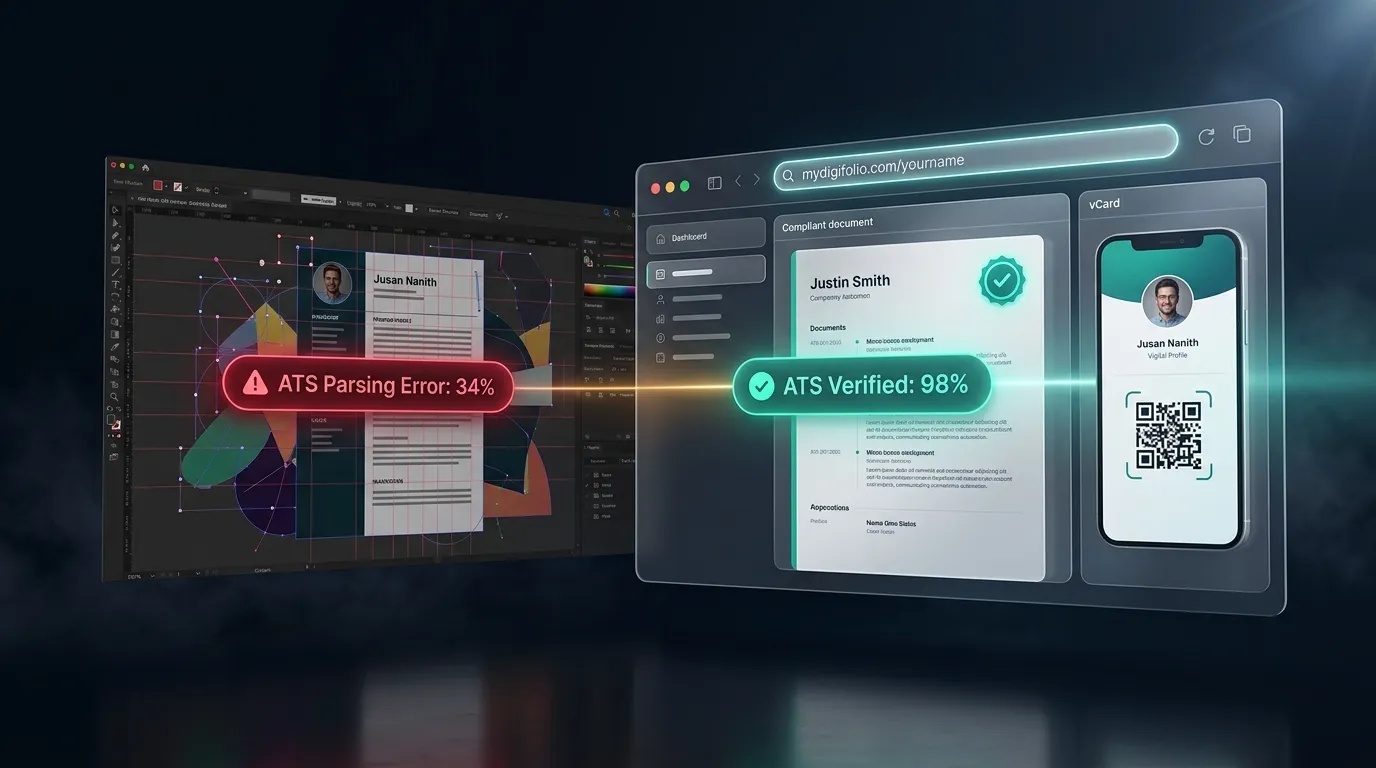
When preparing job applications, turning to graphic design platforms like Canva or complex website builders like Wix and Squarespace feels like a logical choice. These tools offer thousands of colorful templates, drag-and-drop flexibility, and modern visual flourishes.
However, hundreds of thousands of qualified applicants run into an invisible wall: they apply to dozens of roles and receive immediate automated rejections.
The problem is rarely their qualifications or experience. The problem is the tool they used to build their application.
General-purpose design tools are built for visual marketing—such as posters, flyers, and social media graphics—not technical recruitment workflows. Here is why graphic design suites fall short for job hunting, and why a dedicated career platform like MyDigiFolio gives you a clear competitive advantage.
1. The Canva Trap: Why ATS Software Rejects Visual Resumes
Over 90% of mid-sized and large enterprises rely on an Applicant Tracking System (ATS)—such as Workday, Greenhouse, Taleo, or Lever—to ingest, parse, and rank incoming applications before a recruiter ever reviews them.
ATS software does not read a resume visually like a human does. Instead, it parses the underlying file structure, text layers, and coding hierarchy. When you create a resume inside a graphic design tool, severe technical errors happen behind the scenes:
Scrambled Reading Order: Graphic tools treat each snippet of text as an independent coordinate box on a canvas. When automated software attempts to read a multi-column graphic layout, it reads straight across horizontally, blending unrelated job titles, dates, and bullet points into an unintelligible mess.
Unreadable Icons and Progress Bars: Using graphic icons instead of words (such as placing a telephone icon instead of the word "Phone") or visual progress bars for language and technical skills turns your key qualifications into blank fields inside the recruiter's candidate database.
Flattened Vector Fonts: Graphic design platforms often export documents using layered vector paths or custom font subsets that PDF parsers cannot copy, search, or index.
When this occurs, the screening software scores your resume as incomplete or unqualified, filtering out your application before any hiring manager knows you applied.
2. The Maintenance Problem: Disconnected Career Touchpoints
Even if you manage to avoid severe formatting bugs, using standalone design apps creates an inefficient, fragmented workflow:
Repetitive Manual Updates: Every time you complete a project, change roles, or earn a certification, you must update multiple disconnected assets. You have to edit the Canva file, re-export the PDF, log into a website builder to change your portfolio, redesign a digital contact card, and reconfigure your email signature.
Mismatched Personal Branding: Because each asset is created in a separate tool, fonts, colors, and layout styles rarely match, resulting in a disorganized impression across different channels.
Poor Mobile Experience: Sharing static PDF exports or heavy image files over mobile messaging or LinkedIn makes it difficult for recruiters browsing on smartphones to easily read your credentials or open your work samples.
3. Website Builders: Expensive, Complex, and Incomplete
Many job seekers consider setting up a personal portfolio using traditional website builders like Squarespace, WordPress, or Webflow. While powerful, these platforms present their own set of challenges for active job seekers:
Unnecessary Ongoing Costs: Paying monthly subscription fees and annual domain renewals just to host a personal resume page is an expensive overhead for job seekers.
Time-Consuming Setup: Spending days configuring mobile breakpoints, templates, and DNS records takes valuable time away from networking and interview preparation.
No ATS Resume Output: A website builder only provides a web page. It does not generate the standardized, machine-readable documents required by corporate application portals.
4. The Solution: A Unified Career Engine
Job hunting is not a graphic design contest; it is a communication and technical compliance challenge. You need clean, verified information formatted specifically for each audience—both the automated software screening your application and the hiring manager reviewing your work.
MyDigiFolio approaches your professional identity as a single, connected engine:
A Single Source of Truth: You enter your career milestones, project details, and verified skills into your dashboard just once.
Four Synchronized Deliverables: That single profile automatically generates an ATS-friendly resume (in both PDF and DOCX formats), a live web portfolio URL, a scannable vCard QR code, and a formatted HTML email signature.
Instant Real-Time Updates: When you add a new skill or project, all four deliverables update in lockstep across the board, eliminating redundant maintenance.
5. How Dedicated Career Platforms Compare to Generic Builders
When deciding how to manage your career presence, consider the core differences between purpose-built platforms and general-purpose tools:
Core Purpose and Focus: Generic design apps focus on posters, graphics, and social posts. Website builders focus on general business sites and online stores. MyDigiFolio is engineered specifically for career advancement, candidate discovery, and professional presentation.
ATS Compatibility: Resumes exported from visual design canvases frequently suffer from layer conflicts and scrambled reading order. Dedicated career platforms produce standardized, single-column document structures engineered specifically to clear enterprise screening filters.
Setup and Ease of Use: Designing from a blank canvas or building a multi-page website often takes days of manual tweaking. A structured career platform lets you set up an entire online presence in under 10 minutes without any design or coding experience.
Integrated Deliverables: Design tools require you to manually build separate files for your resume, website, and business card. A unified career engine creates your live portfolio link, ATS resume downloads, scannable QR card, and email signature all at the same time from one centralized profile.
Cost: Website builders typically require ongoing monthly hosting fees. MyDigiFolio provides your portfolio page, resume downloads, and networking tools completely free forever, with no credit card required.
Build for Results, Not Just Aesthetics
Visual appeal matters, but getting hired requires satisfying both automated screening algorithms and busy human recruiters. Do not let complex graphic layers or broken document formats cost you an interview opportunity.
With MyDigiFolio, you get a clean, polished digital presence backed by the structured technical formatting needed to pass corporate screening filters—all managed from a single dashboard.