CAREERS
AI Is Changing How Indian Parents Think About Their Children’s Future Careers
MyDigiFolio Editors
2 min read
CAREERS
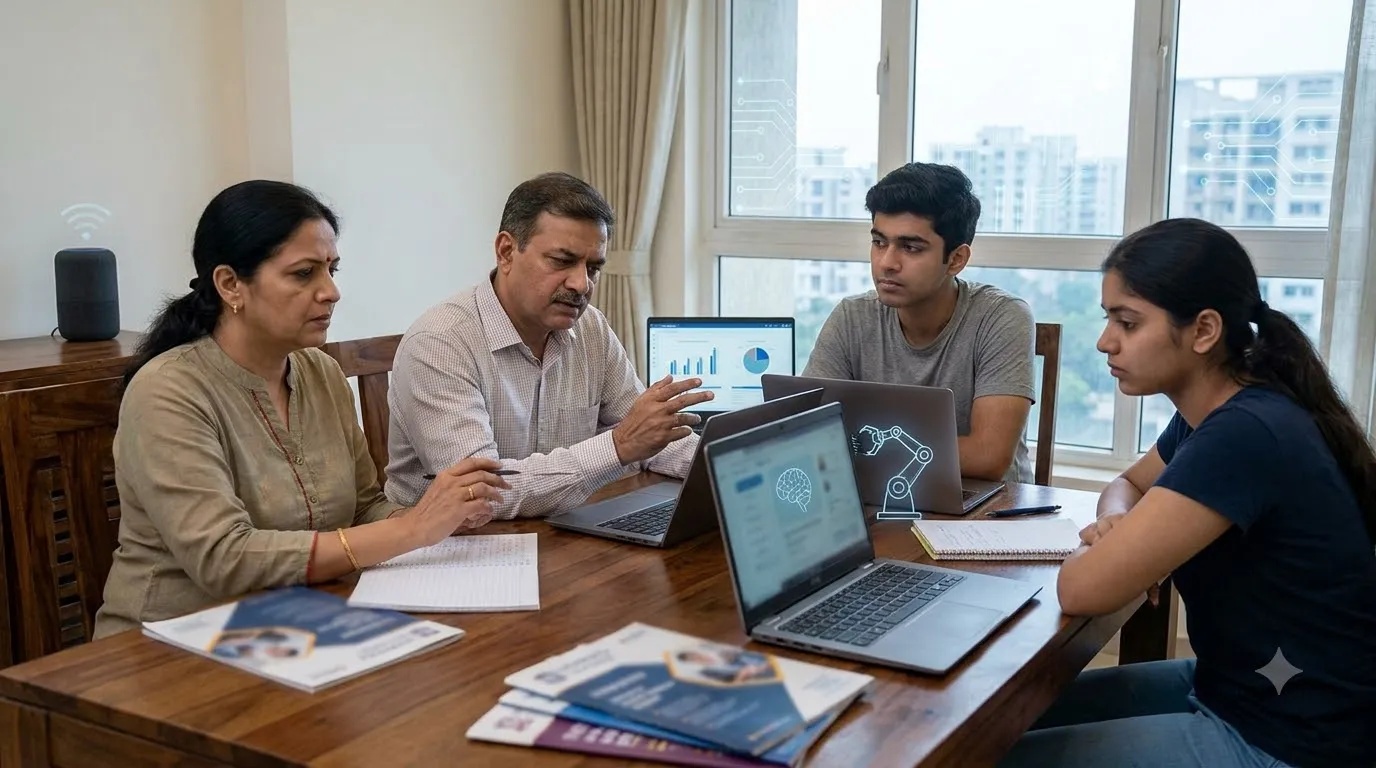
AI is forcing families to rethink what a “safe” career means for the next generation. Instead of relying on one fixed career path, parents and educators are increasingly focusing on adaptability, interests and continuous learning.
Artificial intelligence is making Indian parents rethink how they prepare their children for higher education and careers. Traditional choices such as engineering and medicine, once viewed as relatively secure paths, are increasingly being questioned as AI begins to affect entry-level work.
For many parents, the uncertainty starts well before college. Some are examining university courses and questioning whether a three- or four-year degree will remain relevant by the time their children graduate. Concerns about overseas education have also grown, with some parents questioning whether international degrees still offer the same return on investment.
The changing job market is also influencing subject choices. Computer science, once considered an obvious option for students interested in technology, is no longer viewed with the same certainty by some parents. Others are hesitant about specialised degrees such as data science because they are unsure what related jobs may look like a decade from now.
Some families are instead looking at careers that depend heavily on human abilities. Sports, theatre, acting, psychology, sociology, history and antiques are among the areas being considered because parents and students believe they rely more strongly on human judgement, emotion and personal skills.
Not all parents are allowing AI concerns to determine their children's choices. Some are encouraging their children to explore their interests and make decisions based on aptitude and personal preferences. Psychologists and educators quoted in the article also stress the importance of interest, suggesting that skills can develop when a student is genuinely engaged in an area.
The article also highlights a growing emphasis on adaptability. Rather than preparing children for one fixed career, some experts believe students will need to continuously develop their skills as the nature of work changes. Familiarity with content creation and large language models is among the skills recommended for the changing workplace.
Educational institutions are also responding in different ways. Some colleges are working with IT companies from the early years of engineering education to provide students with workplace exposure and improve their understanding of industry requirements.
The broader message emerging from these discussions is that career planning may need to become more flexible. With uncertainty around future jobs, students may need to keep learning, updating their skills and adapting throughout their working lives.

The Economic Times · 7 hours ago
AI could change more than individual jobs—it could alter how young professionals enter and progress through their careers. As routine entry-...
Reuters · 7 hours ago
Jaguar Land Rover is facing potential job cuts of around 4,000 roles as it works toward £1.7 billion in savings over two years. The UK's bus...

Reuters · 7 hours ago
Permanent staff placements in the UK rose in August for the first time since 2022, pointing to an improvement in hiring activity. However, f...
From MyDigiFolio
One profile. Resume, vCard, portfolio, and email signatures — all generated in 3 minutes.
Build your page — freeWe use essential cookies for login and preferences, and optional cookies for analytics. Privacy policy.